
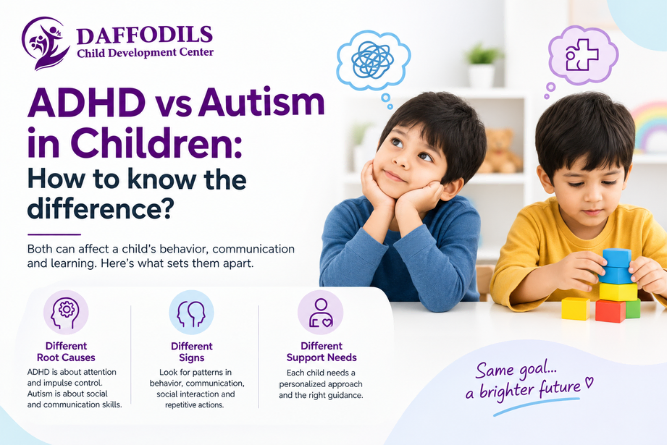
Does your kid face problems sitting quietly, concentrating, or communicating and interacting with other children?You might wonder whether it is autism or ADHD. Searching for ADHD vs autism can help you understand the differences, but they can sometimes be very similar. Some children may have both as well.How then will you be able to tell the two apart? Be aware that your child's behaviour, communication and development should be thought of in the context of the whole, and not one symptom.
ADHD vs Autism – What's the Difference?
Although ADHD and autism are distinct things, they still cause some issues in how children grow and function.Inattention, impulsiveness and hyperactivity are the key signs of ADHD. The difference is that with autism a child's way of communicating is also affected.You may notice that your child:- Gets distracted easily
- Has trouble staying in one place for extended periods of time
- Interrupts or acts without thinking
- Loses instructions or things
- Initiates activities and has difficulty completing them
- Lack ability to converse back and forth
- Have trouble interpreting social signals
- Prefer predictable routines
- Repeat some words, phrases, or movements
- Become extremely focused on specific interests
- Express strong reactions to some sounds, textures, or other sensory experiences
Why Can ADHD and Autism Look Similar?
Such situations may confuse the parents a lot.If a child has ADHD, they may focus on their thoughts and miss what is spoken around them which leads to the child's inability to understand a conversation. Another explanation is that the child who may appear indifferent toward conversations if they are autistic, actually have trouble socializing and communicating through words or gestures.Also, both kids can:- Have trouble making friends
- Challenges with emotional control.
- Experience some situations as being too much to handle.
- Have difficulty following instructions
- Have difficulties in school
What Are the Signs That May Point to Autism?
Communication, social interaction, and behaviour may be affected in diverse ways. Your child might do one of the following:- Does not consistently respond to their name
- May struggle to express interests or feelings
- Has trouble finding a rhythm with another person
- Repeats words, phrases or movements
- Becomes upset when familiar routines change
- Has unusually strong interests
- Reacts strongly to certain sounds, textures or other sensations
Can Speech Delay Be a Sign of Autism?
Not necessarily.If a child has delayed spoken language development, they may simply need support with language development. Delay in speech does not necessarily mean autism and can be caused by a number of factors.But be mindful of what's going on at the same time. For example, does your child also have difficulty:- Using gestures to communicate?
- Sharing attention with you?
- Pointing to show you something interesting?
- Taking turns during interaction?
- Understanding or responding to social communication?
Can a Kid have both autism and ADHD?
Yes. Children may face the two conditions at the same time. Such situations can lead to confusion because it is possible that the symptoms may be similar. For example, one child cannot focus due to ADHD and another child cannot socially interact and/or communicate due to autism.If they both occur, you might experience a mix of:- Inattention and impulsivity
- Social communication difficulties
- Repetitive behaviours or strong interests
- Sensory sensitivities
- Inability to deal with change and feelings
What are the Signs of ADHD and Autism?
A test of blood or pictures cannot tell you if your child has ADHD or autism.A professional typically examines the child's:- Developmental history
- Pupils' conduct at home and school.
- Communication skills
- Social interaction
- Concentration and focus
- Repetitive patterns of behaviour and interests
When to Go to a Physician?
Do not wait until your kid is having major issues before you get assistance. If you are worried, go to a paediatrician or a developmental profesional. You may worry about:- Speech or communication
- Social interaction
- The concentration or activity of a person.
- Learning
- Behaviour
- Sensory responses
- Everyday activities